
At PadMad Kenya, we know that solving period poverty takes more than handing out pads. It requires a complete ecosystem, one that combines education, products and safe environments within a sustainable, circular economy model.
Our Three Key Pillars
Through Sustainable Products
We start at the source by using locally grown cotton and training women from marginalized communities to produce reusable, plastic-free, biodegradable menstrual kits.
These kits last up to five years, reduce waste and save girls up to 96% of costs compared to disposables.
Women who make the pads not only earn dignified wages but also gain skills to run micro-enterprises and supply the wider community.
The Pad kits are distributed directly to schoolgirls and also supplied in bulk to partners such as schools, NGOs, and community groups, ensuring both reach and sustainability.
This model creates a circular economy where nothing is wasted, local resources feed into local production, creating local jobs, while reducing environmental impact. Girls gain affordable products, women gain livelihoods and communities gain resilience.
Building Community Capacity
- Co-create product designs, training materials and quality standards with grassroots innovators and users so solutions are context-fit and locally owned.
- Build local production and micro-enterprise opportunities (training, starter kits, market linkages) so women who use pads can also make and sell them.
- Train and support community MHH (menstrual health and hygiene) champions and peer educators who lead school & village sessions, feedback loops, and local monitoring.
Co-creation raises acceptability and uptake; local manufacturing builds income and sustainability while keeping costs low. Community peer-education increases knowledge, confidence and self-efficacy for managing menstruation. Evidence shows community-led and peer delivery models improve reach and retention for MHH services and product distribution.
- Integrate age-appropriate menstrual health and sexual reproductive health and rights education into school lessons for girls and boys in line with the curriculum.
- Run community dialogues with parents, community leaders and men to unpack taboos and build supportive norms.
- Run social media campaigns to normalize menstruation and reduce shame.
Comprehensive education for both sexes reduces stigma, increases empathy, and lowers teasing and exclusion in schools, which improves attendance and wellbeing. Programs that include boys and community leaders produce measurable shifts in attitudes and reduce discriminatory behaviors.
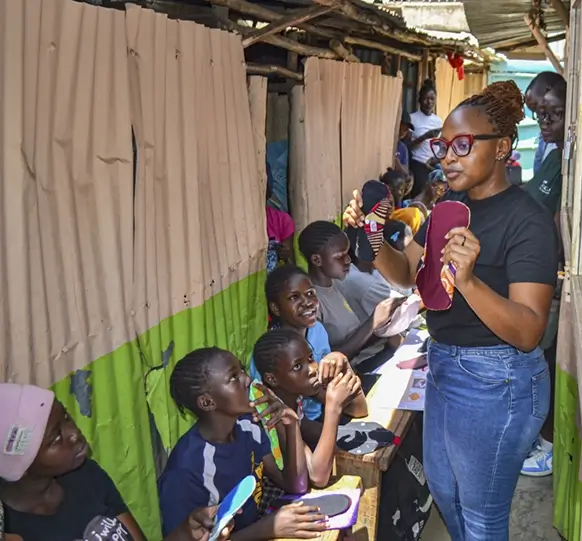
Pair distribution with hands-on training on reusable products (how to use, wash, dry, repair) and menstrual health education.
- Direct product support (coupled with education) reduces period-related absenteeism and improves dignity and participation.
- Community organizations distributing products see improved client engagement and continuity when distributions are linked to education and local follow-up.
- Reusable products also deliver strong environmental and cost benefits over time.
- Work with donors directly providing WASH facilities.
- Propose the upgrade or building of gender-separate, lockable toilets with water inside/nearby, private washing areas, safe disposal options and handwashing stations.
- Work with schools to include MHH indicators in routine school WASH monitoring.
- Train school and community teams committees on routine cleaning and menstrual waste management.
- Pads are only useful if girls have safe, private places to use them. Upgraded facilities not only improve hygiene but also attendance, participation and dignity for girls.
- Adequate WASH facilities are essential for effective MHH; improvements in school WASH plus menstrual education lead to better hygienic practices and higher school attendance. UNICEF/WHO JMP and WaterAid syntheses document that provision of water, private facilities and disposal dramatically improves girls’ ability to attend and participate in school.
Join us in the menstrual movement to end period stigma, period poverty, and reduce waste from disposables!